canon t70 manual

The Canon T70 is a 35mm single-lens reflex camera introduced in the 1980s, offering both automatic and manual controls. It balances ease of use with advanced features, making it popular among photography enthusiasts, though it has some reliability concerns.

Key Features and Specifications
The Canon T70 is a 35mm SLR camera with automatic and manual modes, FD-mount lens compatibility, shutter speeds from 1/1000 to 1 second (plus Bulb), and a built-in motor drive.
2.1 Design and Build Quality
The Canon T70 features a durable design with a mix of metal and plastic components, ensuring a solid feel without excessive weight. Its ergonomic grip provides comfort during extended use. The camera’s build quality is generally robust, though some users have reported issues with the battery door and motor gears over time. The T70’s design balances functionality and aesthetics, making it a practical choice for photographers. Despite its age, the camera remains functional and appealing to enthusiasts, though it requires proper care to maintain its performance and longevity.
2.2 Exposure Modes
The Canon T70 offers a variety of exposure modes to cater to different photography needs. It features a Program mode for automatic settings, Aperture Priority, Shutter Priority, and a full Manual mode for precise control. The camera also includes a dedicated button for adjusting ISO and program settings, allowing users to fine-tune their shots. With its motorized film advance, the T70 provides a smooth shooting experience. The exposure modes are easily accessible via the camera’s intuitive controls, making it suitable for both beginners and advanced photographers. This versatility ensures that users can adapt to various lighting conditions and creative demands with ease.
2.3 Lens Compatibility
The Canon T70 is compatible with Canon’s FD-mount lenses, offering a wide range of creative possibilities. It supports the entire FD lens lineup, including popular options like the 50mm f/1.8 and the 35-70mm kit lens. This compatibility allows photographers to experiment with various focal lengths and aperture settings. The T70 also features a breech-lock lens mount, ensuring secure and easy lens changes. With its versatile lens system, the camera caters to both casual shooters and enthusiasts seeking high-quality optics. The FD-mount ecosystem provides ample opportunities for lens upgrades and customization, making the T70 a flexible choice for different photography styles and preferences.
2.4 Metering System
The Canon T70 features a built-in, through-the-lens (TTL) metering system, providing accurate exposure measurements. It supports both average and center-weighted metering modes, allowing photographers to adapt to various lighting conditions. The metering system operates within a sensitivity range of EV 1 to EV 18, ensuring reliable performance in low-light and bright environments. The T70’s metering is linked to its shutter and aperture settings, enabling precise control over exposure. This system is particularly useful for achieving balanced results in challenging lighting scenarios, making it a versatile tool for both casual and advanced photographers. The manual details how to utilize these metering options effectively for optimal image quality.
2.5 Shutter Speeds
The Canon T70 offers a range of shutter speeds from 1/1000th of a second to 1 second, plus a Bulb mode for extended exposures. These speeds are selectable in both manual and automatic modes, providing flexibility for various shooting conditions. In Program mode, the camera automatically selects the shutter speed based on the scene, while manual mode allows photographers to prioritize either motion freezing or creative effects like blur. The T70’s shutter system is designed for precise control, enabling users to achieve desired effects in both still and dynamic subjects. The manual provides detailed guidance on selecting the optimal shutter speed for different photographic scenarios.

Canon T70 Manual Overview
The Canon T70 manual provides detailed guidance on camera functions, troubleshooting, and settings. Available online as a PDF, it covers essential operations and advanced features for optimal use.
3.1 Obtaining the Manual
The Canon T70 manual can be easily obtained online in PDF format. Websites like Butkus.org and ManualsLib offer free downloads, providing detailed instructions for camera operation, troubleshooting, and maintenance. Users can also purchase printed copies from third-party services if preferred. The manual covers essential functions, shooting modes, and technical specifications, making it a valuable resource for both beginners and experienced photographers. Ensure to download from trusted sources to avoid incorrect or incomplete information. This guide is indispensable for mastering the Canon T70’s features and resolving common issues effectively.
3.2 Language Options
The Canon T70 manual is available in multiple languages, including English, Italian, and others, catering to a global audience. Users can download the manual in their preferred language from websites like Butkus.org or ManualsLib. The English version is the most comprehensive, covering detailed instructions, troubleshooting, and technical specifications. For non-English speakers, translated manuals provide equal accessibility to camera functions and maintenance tips. Ensure to select the correct language during download to fully understand the camera’s features and operation. This multilingual support enhances the usability of the Canon T70 for photographers worldwide.
3.3 Troubleshooting Guide
The Canon T70 manual includes a detailed troubleshooting guide to help users diagnose and resolve common issues. Problems like a non-functional motor, faulty battery doors, or film loading errors are addressed with step-by-step solutions. For instance, if the motor fails to operate, the manual suggests checking battery connections or consulting a repair guide. Battery door malfunctions can often be fixed with minor adjustments or replacements. Film loading issues are resolved by ensuring proper alignment and careful handling. The guide also recommends using specialized tools, like JIS screwdrivers, to avoid damaging internal components. Additionally, online resources and repair tutorials are referenced for more complex fixes, ensuring users can address almost any problem effectively.
3.4 Detailed Settings Explanation
The Canon T70 manual provides a comprehensive explanation of the camera’s settings, ensuring users can fully utilize its features. It covers shooting modes, including Program, Aperture Priority, and Manual, explaining how each mode operates. The manual details ISO sensitivity adjustments, metering options, and flash synchronization settings. Additionally, it explains the function of buttons like the ISO/Program button and how to navigate menu options. The guide also clarifies how to adjust shutter speeds and aperture values, offering practical examples for different lighting conditions. By mastering these settings, photographers can achieve precise control over their images, making the T70 a versatile tool for both beginners and experienced shooters.
Common Issues and Solutions
The Canon T70 often experiences motor and gear issues, battery door malfunctions, and film loading problems. These common faults require careful troubleshooting or professional repair for resolution.
4.1 Motor and Gear Problems
The Canon T70 often experiences motor and gear issues, which can cause the camera to malfunction. These problems may stem from worn or damaged internal components. If the motor stalls or gears jam, the camera may stop functioning entirely. Repairing these issues can be costly and challenging, as specialized tools and expertise are required. In some cases, it may be more economical to replace the camera rather than repair it, especially if the repair costs exceed the camera’s value. Additionally, finding technicians with experience in servicing the T70 can be difficult. Proper maintenance and careful handling are essential to prevent such issues from arising.
4.2 Battery Door Malfunctions
The Canon T70’s battery door is known to be prone to malfunctions, often due to wear and tear or improper handling. Users have reported issues such as the door breaking or not closing securely, which can lead to battery compartment exposure. In some cases, the door may become loose over time, causing the batteries to lose contact and the camera to malfunction. To address this, some users resort to using adhesive tape to hold the door in place. Replacing the battery door can be challenging, as compatible parts are scarce. Regular inspection and gentle handling of the door can help prevent such issues. Ensuring the batteries are properly seated and the door is securely closed is essential for maintaining functionality.
4.3 Film Loading Issues
Some users have reported difficulties with film loading on the Canon T70, despite careful handling. The film may fail to attach properly, leading to loading errors; This issue can stem from improper alignment or tension during the loading process. Ensuring the film is correctly positioned and the camera is on the right setting is crucial. If the film does not advance, it may indicate a mechanical problem. Regular maintenance and careful handling of the film compartment can help prevent such issues. Consulting the manual or online guides for step-by-step loading instructions is recommended to avoid common mistakes and ensure smooth operation.
Maintenance and Care Tips
Regularly clean the camera’s exterior and interior to prevent dust buildup. Store in a dry, cool place to avoid moisture damage. Handle with care to maintain functionality and longevity.
5.1 Cleaning the Camera
Regular cleaning is essential to maintain the Canon T70’s performance. Use a soft, dry cloth to wipe the exterior and lens. For stubborn marks, dampen the cloth slightly but avoid harsh chemicals. Clean the viewfinder and mirror gently with a microfiber brush or lens tissue. Avoid touching the mirror and internal components to prevent damage. For deep cleaning, consider professional services. Store the camera in a protective case to reduce dust exposure. Proper maintenance ensures optimal functionality and longevity of your Canon T70.
5.2 Proper Storage Techniques
Store your Canon T70 in a cool, dry environment to prevent moisture damage. Use a protective case or pouch to shield it from dust and physical damage; Avoid direct sunlight, as it can cause overheating and warping of internal components. Keep the camera away from extreme temperatures and humidity, which can harm the electronics and mechanical parts. For long-term storage, consider using silica gel packets to maintain a dry environment. Always store the camera with the lens cap on to protect the lens from dust and scratches. Avoid stacking heavy objects on top of the camera. Proper storage ensures your Canon T70 remains in excellent condition for years.
Battery Care and Management
Use recommended battery types to ensure optimal performance. Avoid mixing old and new batteries. Store batteries in a cool, dry place to prolong lifespan and prevent corrosion.
6.1 Recommended Battery Types
The Canon T70 requires specific battery types to ensure proper functionality. Recommended options include LR44 or SR44 silver-oxide batteries, known for their reliability and long lifespan. Avoid using zinc-air batteries, as they may cause compatibility issues. Always use fresh batteries to prevent power fluctuations. Mixing old and new batteries is discouraged, as it can lead to inconsistent performance. Store batteries in a cool, dry place to maintain their effectiveness. Avoid exposing them to extreme temperatures or moisture. Using the correct battery type ensures optimal camera operation and helps prevent potential malfunctions. Refer to the manual for detailed battery specifications and guidelines.
6.2 Battery Replacement Procedure
To replace the batteries in your Canon T70, start by locating the battery compartment, typically found on the bottom of the camera. Open the compartment by sliding the latch or turning the dial, depending on your model. Remove the old batteries and dispose of them properly. Insert the recommended LR44 or SR44 batteries, ensuring the positive (+) terminal faces the correct direction. Close the compartment securely to avoid any power issues. Avoid touching the battery terminals to prevent corrosion. After replacing, test the camera to ensure proper functionality. Always use fresh batteries to maintain optimal performance and prevent unexpected shutdowns during use.
Film Loading and Handling
Load film in a dark or low-light environment to prevent exposure. Align the film spool with the camera’s take-up spool, ensuring proper seating. Advance the film to the first frame, then close the back. Set the film counter to match the roll’s length. Handle film gently to avoid creases or tears, and store unused film in a cool, dry place. Always follow the manual’s detailed steps for optimal results and to avoid common loading errors.
7.1 Step-by-Step Loading Guide
To load film into your Canon T70, start by opening the camera back. Ensure the camera is in “Lock” mode to prevent accidental exposures. Insert the film cartridge into the left chamber, aligning the spool with the camera’s take-up spool. Gently pull the film leader across to the right side, ensuring it aligns with the red marker. Advance the film by turning the rewind knob until it stops, indicating the first frame is ready. Close the camera back firmly and set the ISO and frame counter as needed. Avoid exposing the film to light during loading. Handle the film gently to prevent creases or tears. Always refer to the manual for precise steps to avoid common loading errors.
7.2 Avoiding Common Mistakes
When loading film into the Canon T70, common mistakes include improper alignment of the film leader, which can cause loading failures. Ensure the film is securely attached to the take-up spool and not exposed to light. Avoid touching the film surface to prevent scratches. If the film does not advance, check the alignment and retry. Do not force the film, as this can damage the camera’s internal mechanisms. Always refer to the manual for proper loading techniques. Handle the film gently to avoid creases or tears. Double-check the ISO setting after loading to ensure accurate exposures. Proper handling and attention to detail will help prevent issues and ensure smooth operation.
Lenses and Accessories
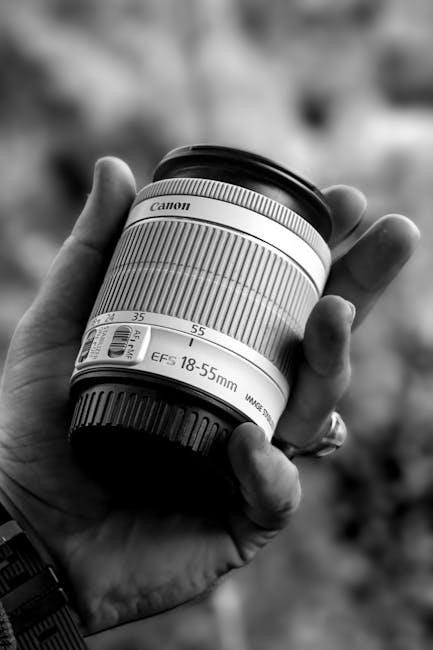
The Canon T70 supports FD-mount lenses, including the popular 50mm f/1.8 and 35-70mm kit lens. Essential accessories include lens hoods, filters, and camera bags for protection and convenience.
8.1 Compatible Lenses Overview
The Canon T70 is compatible with FD-mount lenses, offering a wide range of options for photographers. Popular choices include the 50mm f/1.8 and 35-70mm kit lens, known for their optical quality. These lenses provide versatility for various photography styles, from portraits to landscapes. The T70 also supports other FD-series lenses, such as wide-angle and telephoto options, allowing users to explore different creative possibilities. While the camera does not support modern EF lenses, adapters can be used for compatibility with newer optics. This flexibility makes the T70 a versatile choice for photographers seeking to experiment with different lens configurations and styles.
8.2 Essential Accessories
Essential accessories for the Canon T70 include a sturdy camera strap for secure handling and a lens cleaning kit to maintain optical clarity. A tripod is recommended for stability, especially in low-light conditions. Additional accessories like a battery tester ensure proper power management. A camera bag protects the equipment during storage or travel. Extra film rolls are a must for extended shooting sessions. These accessories enhance the overall shooting experience and help maintain the camera’s performance. They are practical additions for both casual and serious photographers, ensuring the T70 remains a reliable and enjoyable tool for capturing high-quality images.
DIY Repair and Tools
DIY repair requires a JIS screwdriver set to avoid damaging screws. Online guides offer step-by-step fixes for common issues like motor problems, ensuring cost-effective solutions.
9.1 Necessary Tools for Repair
Repairing the Canon T70 requires specific tools to avoid damaging the camera. A JIS screwdriver set is essential, as the screws appear similar to Philips-head but are not compatible. Using regular screwdrivers can strip the screws, so investing in a JIS set is crucial. Additional tools include plastic spudges for gently prying open components, a torque driver for handling delicate parts, and magnifying tools for inspecting small mechanisms. Online resources often recommend these tools for DIY repairs. Ensure you have a clean, static-free workspace to prevent further damage. Proper tools are vital for successful repairs and maintaining the camera’s functionality.
9.2 Basic Repair Steps
Begin by preparing a clean, static-free workspace. Remove the batteries and film to prevent damage. Use a JIS screwdriver to carefully disassemble the camera, starting with the battery door and working through external screws. Gently pry open components with plastic spudges to avoid scratching; Inspect internal mechanisms for dust or debris and clean with compressed air. Lubricate gears if necessary, but avoid over-lubrication. Reassemble in reverse order, ensuring all screws are securely tightened. Test the camera’s functions post-repair. Always refer to the Canon T70 manual or online guides for specific instructions to avoid further damage. Patience and precision are key to successful DIY repairs.

Comparison with Other Models
The Canon T70 stands between manual dial cameras and modern SLRs, offering unique functionality. It compares closely to the T50 but features distinct lens compatibility and operational styles.
10.1 Canon T70 vs. T50
The Canon T70 and T50 share similarities but differ in features and build quality. The T70 offers more advanced functionality, including additional shooting modes and a sturdier design. While the T50 is more basic, it is known for its reliable operation and simpler interface. Both cameras use FD-mount lenses, but the T70 supports more accessories. The T70’s motorized film advance provides a unique shooting experience, though some users prefer the T50’s quieter mechanism. Battery door issues are common in both models, but the T70 generally has better weather sealing. Overall, the T70 is preferred for its versatility, while the T50 remains a budget-friendly option for casual photographers.
10.2 Comparison with Other Brands
The Canon T70 stands out among other brands for its unique blend of automatic and manual controls, appealing to both casual and advanced photographers. Compared to models from other manufacturers, the T70 offers a distinctive motorized film advance and a robust build quality. However, its reliability issues, such as battery door malfunctions, are more prevalent than in some competitors. While other brands may offer quieter operation or simpler interfaces, the T70’s versatility and compatibility with FD-mount lenses make it a strong contender. Its balance of features and affordability positions it as a mid-range option, though users may need to weigh its quirks against the reliability of other brands.
History and Legacy
The Canon T70, introduced in the 1980s, is a 35mm SLR that bridges manual and automatic photography. Its unique design and features have made it a collector’s favorite, despite reliability issues.
11.1 Historical Background
The Canon T70, introduced in the 1980s, is a 35mm single-lens reflex camera that marked a significant step in Canon’s evolution. It was designed as an intermediate model, blending automatic features with manual controls, making it accessible to both enthusiasts and professionals. The T70 was part of Canon’s FD-mount system, which was widely popular at the time. Its design reflected the transition from mechanical to electronic cameras, offering a modern aesthetic and functionality. Despite its innovative features, the T70 faced reliability issues, which somewhat tarnished its reputation. However, it remains a notable piece in Canon’s history, contributing to the company’s growth in the SLR market.
11.2 Collector’s Value Today
The Canon T70 has gained a niche following among collectors and vintage photography enthusiasts due to its unique blend of automatic and manual features. While not as highly sought after as some professional-grade models, its historical significance and nostalgic appeal drive its collector’s value. The camera’s distinctive design and functionality make it a desirable piece for those interested in 1980s photography technology. However, its reliability issues and common malfunctions, such as motor and battery door problems, can affect its resale value. Despite this, the T70 remains a cherished item for many, especially when paired with its original manual and accessories.

Multimedia and Online Resources
Video tutorials and online forums provide valuable insights into the Canon T70’s operation and maintenance. Websites like Butkus.org offer free PDF manuals, while YouTube channels share hands-on guides. Repair tips and user discussions are readily available, making it easier for enthusiasts to troubleshoot and master their camera.
12.1 Video Guides and Tutorials
YouTube channels like “Film Photography 101” and “Analog Insights” offer detailed video guides for the Canon T70, covering topics such as film loading, manual mode operation, and troubleshooting common issues. These tutorials provide step-by-step instructions, making complex tasks easier to understand. Additionally, repair-focused videos on platforms like “learncamerarepair.com” demonstrate DIY fixes for motor and gear problems, empowering users to maintain their cameras independently. These resources are invaluable for both beginners and experienced photographers, ensuring the Canon T70 remains a functional and enjoyable tool for capturing high-quality images.
12.2 Online Communities and Forums
Online forums like Reddit’s r/Photography and specialized film photography groups are hubs for Canon T70 discussions. Users share tips, troubleshooting solutions, and personal experiences. These communities often include detailed threads on repairing common issues like motor malfunctions and battery door problems. Enthusiasts also post photos taken with the T70, showcasing its capabilities and inspiring others. Forum members frequently recommend repair resources and provide guidance for DIY fixes, making these spaces invaluable for both new and experienced T70 users. Additionally, many forums offer access to user manuals and repair guides, further enhancing their utility for Canon T70 enthusiasts.
The Canon T70 remains a notable camera in film photography history, offering a blend of automatic and manual features that appeal to both enthusiasts and collectors. While it has its quirks, such as motor issues and battery door problems, the T70’s unique design and compatibility with FD lenses make it a cherished choice. Proper maintenance and care are essential to extending its lifespan. For those seeking guidance, online resources like the Butkus manual provide invaluable support. Whether you’re a seasoned photographer or a newcomer, the T70 offers a rewarding shooting experience. Embrace its character, explore its capabilities, and enjoy the journey of film photography with this iconic camera.